Why would a skincare brand build its products around a mushroom? Because Japan has spent more than a thousand years choosing which fungi to keep, and snow mushroom skincare is one of the newest results.
The best proof is a mold. On October 12, 2006, twenty years ago this month, the Brewing Society of Japan named koji its national fungus, or kokkin. Without koji, there is no miso, no soy sauce, no sake and no mirin.
Koji's scientific name is Aspergillus oryzae. The idea to make it the national fungus came from Eiji Ichishima, a fermentation scientist at Tohoku University.
Koji is not a wild mold. People have bred it over centuries, the same way they bred wheat and dairy cows. Some of its wild relatives make toxins. Koji does not.
In 2005, scientists mapped koji's genes and published the results in Nature. They found about 12,000 genes. An unusually large number of them do one job: breaking protein, starch and fat into smaller pieces. Those pieces are what we taste as sweet and savory.
Brewers had been choosing those genes for centuries. They just didn't know it.

In Kyoto's Gion district, a shop called Hishiroku has sold one thing for over three centuries: tanekoji, or seed koji. These are the dried spores that start every batch of miso, soy sauce or sake.
Only a handful of seed-koji makers are left in Japan. Hishiroku is the oldest.
The work has barely changed:
Someone checks it, turns it and adjusts the room, day and night.
Koji isn't so much made as looked after, like a fire that needs feeding.
The same mold gave skincare one of its best-known ingredients. In 1907, the scientist Kendo Saito found a new compound in koji and named it kojic acid.
The Japanese beauty company Kosé tells the story of how interest in it grew. Sake brewers worked rice koji by hand for years, and people noticed their hands were unusually pale and smooth.
Here is why. Kojic acid blocks tyrosinase, the enzyme that starts the production of melanin, the pigment that darkens skin. Japan approved kojic acid as a brightening ingredient in 1988. Today it is used in skincare around the world.
The West perfected removing the microbes that harm us. Germ theory, clean surgery and pasteurization are some of the most important ideas in modern medicine. Washing germs away has saved a great many lives. That is a good answer.
Japan kept asking a different question: which microbes are worth keeping?
Today, the two ideas are meeting. In 2013, David Whitlock, an MIT-trained chemical engineer, said he had stopped washing with soap more than ten years earlier. Instead, he sprayed his skin with live bacteria that feed on the ammonia in sweat. In 2014, the company he co-founded, AOBiome, turned that spray into a product.
Whitlock got there by experiment. Japan's brewers got there by doing the same work for centuries. Both reached the same idea: some microbes are worth keeping.

What snow mushroom actually is
A common mistake is to think mushroom skincare means putting living fungi on your face. It doesn't.
Snow mushroom (Tremella fuciformis) is a white, see-through, jelly-like fungus. It grows on fallen hardwood branches and looks a bit like coral. In Japanese it is called shiro-kikurage, or "white wood ear."
Skincare uses an extract from it. That extract is rich in polysaccharides, which are long chains of sugar that hold water. On skin, they keep moisture at the surface, much like hyaluronic acid.
To be clear about where it comes from: snow mushroom's long history as food belongs mostly to China, where it is cooked into sweet soups. What is Japanese is the way of thinking. Choose a fungus for what it does well. Then keep it, with care, for a long time.

These steps work with any hydrating serum and moisturizer. The order matters more than the brand.
Wash with lukewarm water, not hot. Use a gentle cleanser, such as our Mushroom Enzyme Cleanser, that leaves skin clean but not tight.
Apply serum while your skin is still damp. Do it within a minute of patting dry. Press two or three drops of a snow mushroom serum, such as our Snow Mushroom Serum, into your face and neck. It holds water best when there is water to hold.
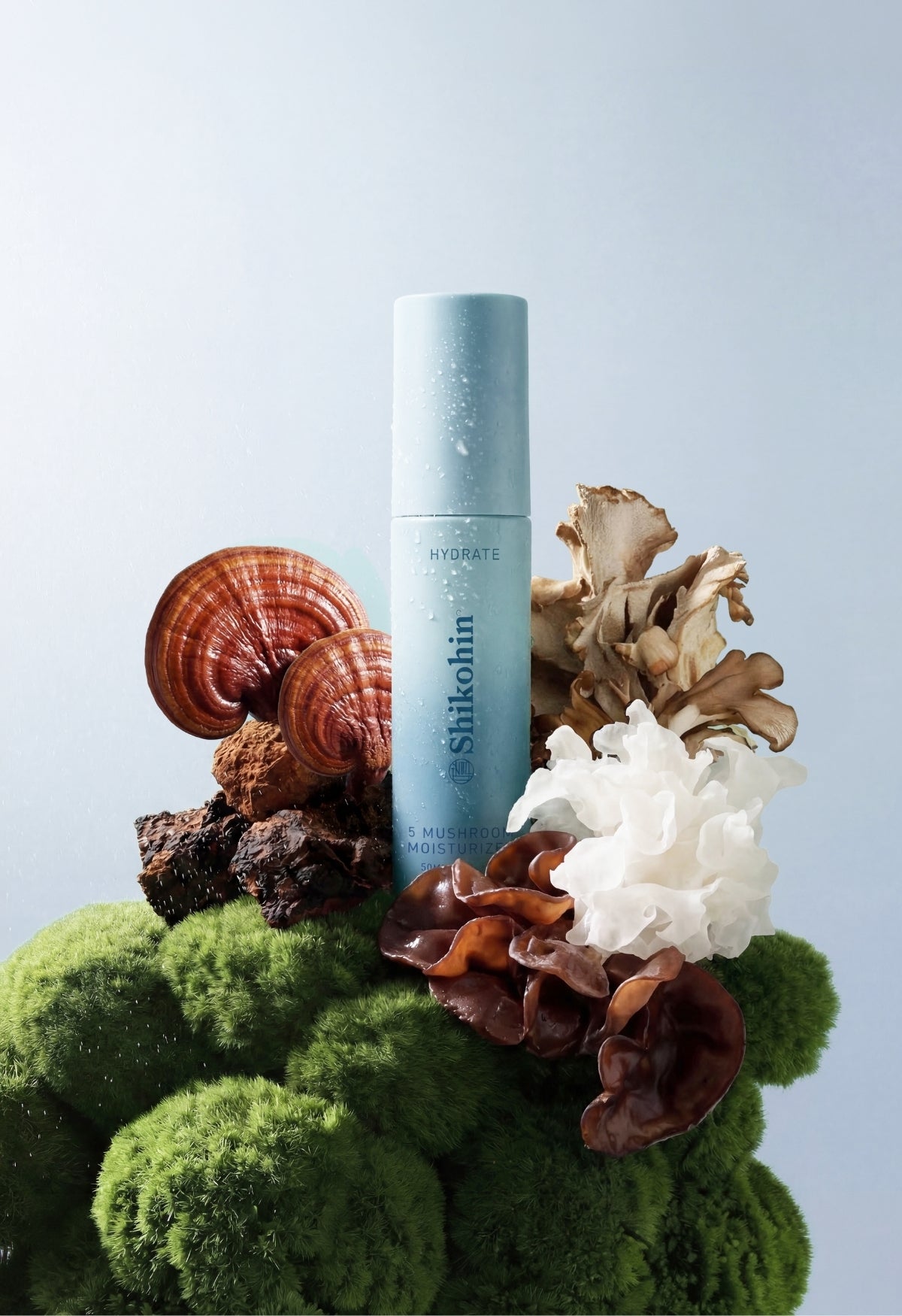
Seal it in with moisturizer, such as our 5 Mushroom Moisturizer, so the water stays on your skin instead of drying off.
Do it morning and night. Hydration works as a daily habit, not a one-time fix.
One more thing to try this week, in the kitchen: When you make miso soup, turn off the heat and let the bubbling stop before you stir in the miso. Japanese cooks have always said miso should never boil. It keeps the flavor, and the live bacteria in unpasteurized miso don't survive boiling.
In a warm room in Gion, a tray of rice is slowly turning yellow-green, and someone will check on it again before morning.
Shikohin ritual: Snow Mushroom Serum, 5 Mushroom Moisturizer and our Mushroom Enzyme Cleanser share koji’s way of thinking: choose a fungus for what it does well, then keep it with care. A different organism, the same idea, with functional mushrooms chosen and formulated on purpose.
Sources

Culture
Culture
Culture


Free from synthetics for gentle care


Leaping Bunny certified for a kinder world


No animal-derived ingredients for conscious skincare


Uncompromised health and results


Traditional ingredients for modern healing


Rigorous quality, safety, and purity checks